Tuesday, June 2, 2026

Copper and Lemons

 I just got this back from the framer today, so I thought I might feature it here. Lets start with a sketch:


I posterised the image of the set-up, and used the reduced colour range to scribble in the colours and values, using this swatch.


Now I chose a different swatch for the lemons.

And for the jug.
Using both those swatches to select a sub-set of pastels, I painted over the underpainting of hard pastels with soft sticks from Schminke and Sennelier mainly.

The colander was next in line.


I added Blue Earth to the pastel sticks for this section, as shown above. A nice range of browns, earths, ochres, all contribute to a realistic copper pan.

All that remains is the kettle - and of course the background, which is Schminke neutral grays.


Copper and Lemons, 45 x 39 cms. © Niall O'Neill. P.S.A.

Wednesday, May 27, 2026

Peppers and Persimmons

 It's been some time since I posted any  new pastels here. So I have some catching up to do.
This latest is a painting I made of a present of peppers in an orange pot, that I teamed up with some persimmons I had to hand. The different nuances of orange in peppers, pot, and fruit grabbed my attention.

This first image is the scribbled sketch, using pastel pencils to define objects versus negative spaces. The second one is the sketch blended.


I used an image reduced to 16 colours to decide on this first layer.


Colours for the peppers:

Peppers painted in soft pastels:

Colours for the Plant pot:

And for the fruit:


Once the background was filled in, and some tweaks added, the work was finished.

Pepper and Persimmons, Pastel on Clairefontaine Pastelmat, 9.5 x 11 ins, or 24 x 28 ins.
© Niall O'Neill, P.S.A.


Monday, February 7, 2022

Brasserie

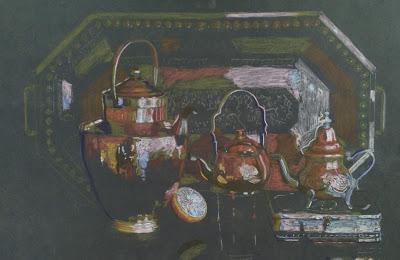
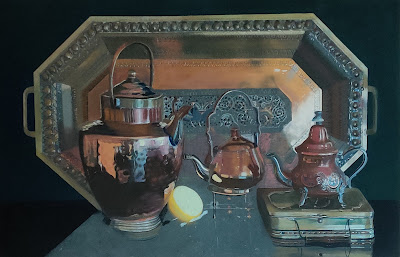
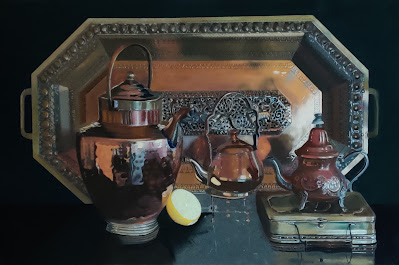
I have a collection of copper and brass pots and an intricate brass tray, that I wanted to paint as an ensemble. This is the set-up:


Using an editing program, I reduced the photo to 16 colours - I call this process the "digital squint" - equivalent to squinting your eyes to simplify an image and better determine the values.

Using the swatch, I chose the initial colours for the underpainting, and scribbled them in with pastel pencils and hard pastels.


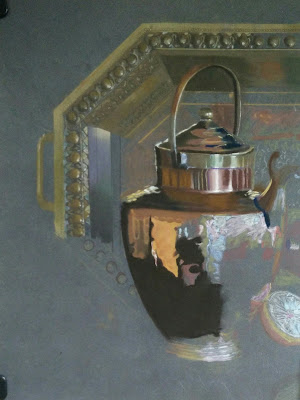
Working from top left, I started painting the corner of the tray, and the copper tea-urn. Rembrandt umbers were very useful.


More pots worked on, and the lemon - what's tea without a lemon?


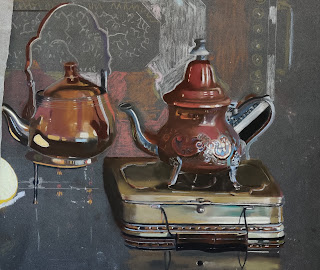
The copper tea-pot on the right had it's own colour swatch and subset of pastels:


Tray background begins to get filled in. I use glassine paper to protect areas already completed as I work.


Intricate detail of tray worked with various pencils and sharpened Rembrandts:


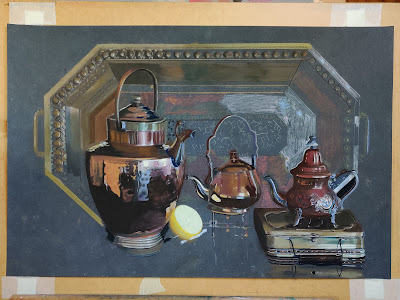
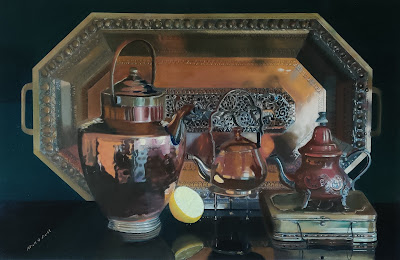
Reflections painted, final tweaks- signature! Pastels used were Rembrandt, Sennelier, Blue Earth and Roché
Brasserie - pastel on Pastelmat, 17.5 x 26.5 ins, 45 x 58 cms


Brasserie  © Niall O'Neill

Saturday, May 15, 2021

FUNGUS

I haven't posted here in a while. not because I haven't been painting, but because I have been exploring other mediums. However, after buying Dan Massad's Palmer Museum retrospective catalogue/monograph I thought I might like to try a stark image against a  black background - something I hadn't done before. This striking image of a fungus was taken by by Mick Grant, who kindly gave me permission to use it..

This is the initial sketch and scribbled infill using pastel pencils on a grid drawn only where the image will sit.


Much of the caps is completed using a variety of soft pastels, Rembrandt, Sennelier, and Roché, and a contrasting black background is filled in using pastel pencils around the edges of the mushrooms, with Rembrandt black pastel sharpened to a point.


I started work on the stems, using mostly Rembrandt grey, blue grey, mouse grey, and green grey, and extended the black background.


The background is extended fully and I began to cover the slightly greasy Rembrandt black with the softer, more matt, but also more dusty Roché black.

The bottom of the painting is not black, but very dark green, on which the mossy ground is painted.
"Fungus" © Niall O'Neill

This is the palette, colour chart, or "nuancier" that I used. It is quite extensive for such an apprently simple subject.


I framed the finished painting behind museum glass. It measures 14 x 11 inches, or 35.5 x 28 cms, and is painted on Clairefontaine Pastelmat.


Monday, October 7, 2019

Campsis after Rain

For the circumstances regarding this flower with raindrops, see previous post.
I'm going a little deeper into my method here. The first image is a photograph of the flowers reduced to 16 colours in Paint Shop Pro, with a 10 x 8 grid imposed (my support will be a 10 x 8 in. piece of Pastelmat).

Now you can use the colour palette in Paint Shop to make a swatch, so that the underpainting is reduced in complexity of colour although the tonal range is not altered.

I used this as basic palette to to the first sketch.

Followed by a bit of quick blending.

I usually select a subset of soft pastels to cover all potential colours and values in a painting. This is the selection, and the "nuancier". It includes Rembrandts (top left), Artisan Pastellier, Blue Earth yellows, some Schminke, and Senneliers, bottom rows.

I chose to give a pink bias to the top flower, and once done put in some background to see view the contrast. I used Sennelier dark green 177.

I decided to exaggerate the orange-yellow tints of the bottom flower.

Back to the top right, and the pinkish flowers, finish background, and sign. Job done!
Campsis after Rain © Niall O'Neill

Hibiscus after Rain

After two weeks of unremitting heat in early July, the temperature dropped from 39-40 degrees Celsius and it rained - just for a day - on July 26th. So I took some pictures of this Hibiscus Blue Bird (and a Campsis or Trumpet flower) and decided to paint it.
The first picture shows the support, some scribbled petals, and a colour chart of the few pastels used to get me to this point - CarbOthello in the main.


The pencils are fine for initial drawing, but not for painting, with the exception of the stigmas and pistil in the flower's centre. After checking all my blues, I decided on Sennelier 334, 335 and 336 as being the most suitable for colour and for a subtle movement of tone within the hue.


The dark centre was put in using Unison, and all the raindrops were outlined. The centre was enhanced with some subtle touches of very dark red from Roché. Once the petals were near completion I put in some Sennelier 434 dark blue to see how the background would show up the bloom.


It only remained to finish the leaves - not too much detail needed here -  finish the background, and sign! The finished piece is on Pastelmat, 10 x 8 ins or 25 x 20 cms.
Hibiscus after Rain © Niall O'Neill